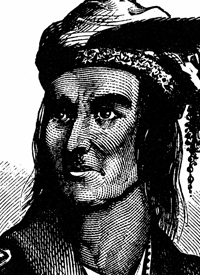
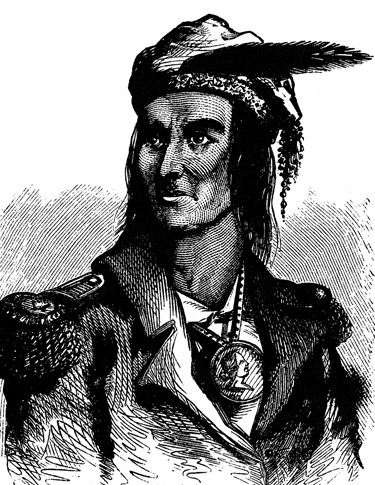
Jefferson’s assumptions proved to be wrong. In fact, the small British and American Indian forces in Canada repeatedly defeated the American invasion attempts in 1812 and 1813. Reliance on the state militias proved a disaster. Having had no professional training, many militiamen broke rank and fled when attacked. The American regular army performed almost as poorly. One blundering general, William Hull, surrendered Detroit to a much smaller British force commanded by Isaac Brock and assisted by American Indians led by Tecumseh. Instead of bolstering American pride, the attempted invasion of Canada only further embarrassed the nation.
Victory Against the American Indians To the surprise of many Americans—and to the shock of the British—the small American navy performed well, capturing four British ships during 1812. On Lake Erie, American ships led by Oliver Hazard Perry defeated a British flotilla in 1813, enabling an American army, commanded by William Henry Harrison, to retake Detroit.